This speech by Barack Obama engages the reasons why I participate so passionately in politics. I only hope that I can become half as principled, eloquent, and bold as Obama. You can accept or reject his "progressive" stance on the issues, but surely you can respect his honest passion to bring positive change to America. Here is an excerpt:
" She believed that we don't have to settle for equality for some or opportunity for the lucky or freedom for the few. And she knew that during those moments in history where it looked like we might give up hope or settle for less, there have always been Americans who refused. Who said we're going to keep on dreaming, and we're going to keep on building, and we're going to keep on marching, and we're going to keep on working because that's who we are. Because we've always fought to bring all of our people under the blanket of the American Dream. "
Friday, June 23, 2006


Saturday, June 17, 2006
Inconsistency, Hypocrisy, and the Mis-informed
Nothing bothers me in this world more than people who commit the following faux pas - Inconsistency, Hypocrisy, and acting on Mis-information (or none at all). This is especially maddening when it is policymakers, people in great power, or radical policy-pushers who commit these egregious errors.
First, consistency is a must in applying values, ideas, and dedicating yourself to a cause. Now, consistency is not the same thing as mechanical, habitual, or just plain monotonous. Nor does consistency mean you can't change your mind occasionally when you have gathered new information or you have found that applying information in a new way gains a new conclusion. What consistency does mean, especially in the idealistic sense (as in the application of ideas), is that one uses definitions to mean the same thing every time they use them, it means that one applies their values equally without picking and choosing when it applies, and it means that one has a system of beliefs that are reconcilable. Consistency is not always possible in all situations, and people are not perfect at application, but many, especially when it comes to policy and politics, pick and choose ideas, values, morals, belief systems, facts, assumptions, logic, etc as it meets the needs of the situation, without any real consistency. This type of inconsistency truly drives me crazy!!!
Secondly, closely related to inconsistency is hypocrisy! Hypocrisy involves action - one holding or talking about beliefs that they hold, but then acting in a manner that is totally contradictory and insolent. You know a real hypocrite when you see/hear one, because she/he will always say things they think that people want to hear and then go out and do whatever the hell they want. I have no problem with one who honestly changes their mind or heart based on new evidence or a new understanding. In fact, I applaud people who are honest enough and secure enough to be able to declare that they were wrong in the past. When one can't admit to past mistakes or admit to new understanding, they become arrogant, proud, and stubborn in the worst way. I have no room for blatant hypocrites. Please if you ever see me being hypocritical please let me know (politely) so I can fix my mistake.
Finally, acting on mis-information or no information at all is the most unnerving faux pas! Sure, it's not possible for most of us to have a complete grasp on most issues, but you at least have to try to understand what you are talking about. You have to have at least some basis for your beliefs. If you're going to write or criticize policy I would hope that you at least have some experience, knowledge, or understanding of the topic or issue. One example that really upsets me is when people say say the following about people with disabilities - "Oh - that is so horrible how he/she suffers like that - I would NEVER want to live like that?" How in the world could they possible know what it is to "live like that???" Why are people so quick to judge what it must be like to live with a disability with absolutely no understanding of the quality of life that people with disabilities enjoy. This also applies when people make the false assumption that it might just be better to abort a baby who will be born with a disability and "suffer" then to let them live. This view is often based on a completely erroneous conception that the only possible life one with a disability one can live is one of pain, inferiority, and diminished quality of life. It is true that many people with disabilities have historically (and still continue) to live sub-human and oppressed lives. Fortunately, many do not, and there is no law that says that it is the way that it has to be. The other group of egregiously mis-informed are the biblethumping Jesus freaks who have absolutely no idea what their religion or beliefs mean. They spew out bible quotes and repeat sermons, but without any clue what the words even mean. When you question or challenge them, they simply quip back, "it's in the bible it must be true." Please don't get me wrong - I have nothing against people who have a deep and affirmed faith or belief system. I just think that one must actually know what it is that they believe. It only makes sense that when one has questioned their ideas, beliefs, and values they will have a deeper and more profound connection to the belief, because now they have had the opportunity to internalize and reason these important ideas.
In the end I don't care what ideas and beliefs you hold as long as you faithfully apply all the above when arriving at your conclusion.
Saturday, May 13, 2006
Liberty and Safety
"Those who would give up Essential Liberty to purchase a little Temporary Safety, deserve neither Liberty nor Safety. " ---Benjamin Franklin
Ever since Leslie Cauley reported in USA TODAY an NSA wiretapping database that keeps and monitors the records of domestic phone calls made by millions of Americans, there has been much talk about the legality of the program, and what this means for privacy and civil liberties of Americans. While I have been unable to read/listen to all the talk, I thought I would weigh-in on this important issue.
It seems that two equally important threads have started over this issue: 1) Is such a program by the NSA illegal? And if so, why are we not calling for President Bush's impeachment? and 2) What does surveillance of Americans mean for our privacy and civil liberties?
I'll say that I am not a lawyer, but this program seems highly suspect as to its legality. Without a warrant to investigate a citizen of the United States, I do not see how any law enforcement, intelligence, or government agency of any sort can search, wiretap, or obtain any information about citizens. And if this program is illegal, I am deeply concerned with what this could mean for the future of the Republic, especially if the President is not held responsible.
As for privacy, I have this oddly disconcerting thought - I was not surprised by the revelation that the NSA is listening to my calls because I already figured they were intercepting my communications. Yes, it scares me that I had already resigned myself to this reality, and without thoroughly considering the consequences. The truth is, I do not know the consequences, but I do know they could be heavy, and that spying on citizens is a serious subject. I do believe there is an important link between privacy and freedom - how can one be free if she is not allowed to have a domain of autonomy independent from the watchful eye of the government? Yet, at the same time I figure, why am I so worried, I am a law-abiding citizen, they can't charge me with anything, and I still have the courts right? I already realize that public space is incredibly not private, so why not have the cameras, satellites, and computers monitor everyone and find the bad guys for my protection? I'd say there is surely an argument for safety, protection, and security, but at what price? At what point does the government stop monitoring its citizens for their own protection, and start monitoring them for its own protection??? It is exactly this dilemma that can separate a democratic state from an authoritarian one, and I am not sure I am willing to take that risk. Which is why I refer to the Ben Franklin quote above. How much liberty are we willing to risk for safety? At what point do we realize that freedom comes with inherent risks and we must live with those risks?
Sunday, April 30, 2006
That Anti-Civil Rights Editorial
The following editorial appeared in the New York Sun on April 20, 2006:
The Anti-Disabled Act
http://www.nysun.com/article/31348 :
New York Sun Editorial
April 20, 2006
Guess which piece of liberal-do-gooding may be at fault for bringing to an end the free steak dinners a famed Washington D.C. eatery was giving each week for wounded war veterans. That's right, the Americans with Disabilities Act. The restaurant is Fran O'Brien's Steakhouse, which has been making this wonderful
gesture for wounded GIs, many of them amputees, from Walter Reed army hospital every week for some two and a half years. But Hilton is refusing to renew
the restaurant's lease and given Fran's, a Washington institution for decades, until May 1 to leave.
The hotel is tightlipped about the reasons for the decision - a spokeswoman did not return our call for comment - but some are starting to suspect the Hilton has been scared off by the Americans with Disabilities Act. The restaurant sits in the basement of the hotel and is accessed via either of two staircases.
If neither of these is feasible for a patron in a wheelchair, the only alternative is the hotel's supply elevator, accessed via a locked coatroom at the lobby level and a long L-shaped hallway in the basement.
Veterans attending the free dinners have never actually complained about the accessibility problems, a co-owner of Fran's, Hal Koster, told us when we stopped by recently. But as part of an on-again, off-again lease negotiation, the restaurant eventually asked the hotel to make the facility ADA-compliant. At about that time, negotiations seem to have ended. The hotel and the restaurant exchanged letters about the conditions under which each party would be willing to renew (the hotel wanted a new carpet and a refinished bar, for example), most of which the restaurant was willing to fulfill. The only bone of contention, apart from handicap access, appears to have been whether to upgrade or replace the wonderful booths once enjoyed over the years by the likes of President Nixon.
The thinking among some of the restaurant's supporters seems to be that the landlord, given the potential burden of a suit under the ADA (although as far as anyone knows, no one has threatened such a suit at this point), figures it would be cheaper to evict a famous steakhouse and let prime commercial space in the heart of Washington lie fallow. The last any of the parties knew, Hilton has budgeted money in 2007 to install a lift, after which it will likely re-lease the space, although Fran's may be installed in a new home by then.
We're sympathetic to the restaurateurs, not to mention the vets, in their desire for an accessible restaurant, but there's got to be a better way than the ADA to accomplish that. Instead, the ADA makes it financially safer for the hotel to evict the restaurant and leave its location empty than to allow Fran's to operate in the interim. Another local hotel has agreed to host the veterans' dinners, and although they're grateful to their new hosts, the guests will miss the sports bar feel of Fran's. If it turns out that it was the ADA that put an end to Fran's great tradition, it's one of the most ironical results in the history of do-gooding.
--------
I am not sure whether I am more appalled by the ignorance of author, or the fact that such uninformed blasphemy was allowed to make it to print. However, there is obviously a major problem of understanding when it comes to the Americans With Disabilities Act (ADA). I do not know if this misunderstanding results from institutional and societal perpetuation of myths about people with disabilities or whether it stems from the inability of the disability community to communicate our position in society. I believe it is probably a combination of both, which is why I am taking the time today to remedy the latter.
First, it must be understood that the ADA was not a "piece of liberal do-gooding" legislation. The ADA was signed into law by Republican President George HW Bush in 1990 after receiving wide bi-partisan support by Congress. If the author meant "liberal" in the sense that it was a progressive piece of legislation that dared to override the status quo then he is surely correct. But he is incorrect in his labeling the act as "do-gooding" as the ADA was not about doing good or random acts of kindness, it was about doing right; about giving full civil rights, equality, and empowerment to people with disabilities.
Second, as a person with a disability who uses a wheelchair and who has had to endure a loss of dignity by being forced to ride in freight elevators and seriously bereft, shaky, forgotten elevators; being led on deleterious detours by kitchens. dumpsters, and Timbuktu; and forced to be segregated from peers in order to dine at a restaurant, watch my government in action, access businesses, participate in community events, watch shows (which I paid for), and generally participate fully and independently in all that America has to offer - I know first-hand the importance of the ADA. The ADA is a civil rights law and it was made law in order to give people with disabilities full freedom, choice, and access to residency, employment, education, and society without discrimination. It is pathetic that after 15 1/2 years of being law, only a minority of the public understands the purpose and intent of the ADA. Yet, if this author had called the Civil Rights act of 1964, Women's Suffrage, or the 14th Amendment a "piece of liberal do-gooding" and wrote that these important civil rights laws were ironically anti-rights there would surely be an uproar by women, blacks, minorities, and the population at large. So I ask, why is there not an equal uproar over slanderous rhetoric aimed at an equally important civil rights law!
The Anti-Disabled Act
http://www.nysun.com/article
New York Sun Editorial
April 20, 2006
Guess which piece of liberal-do-gooding may be at fault for bringing to an end the free steak dinners a famed Washington D.C. eatery was giving each week for wounded war veterans. That's right, the Americans with Disabilities Act. The restaurant is Fran O'Brien's Steakhouse, which has been making this wonderful
gesture for wounded GIs, many of them amputees, from Walter Reed army hospital every week for some two and a half years. But Hilton is refusing to renew
the restaurant's lease and given Fran's, a Washington institution for decades, until May 1 to leave.
The hotel is tightlipped about the reasons for the decision - a spokeswoman did not return our call for comment - but some are starting to suspect the Hilton has been scared off by the Americans with Disabilities Act. The restaurant sits in the basement of the hotel and is accessed via either of two staircases.
If neither of these is feasible for a patron in a wheelchair, the only alternative is the hotel's supply elevator, accessed via a locked coatroom at the lobby level and a long L-shaped hallway in the basement.
Veterans attending the free dinners have never actually complained about the accessibility problems, a co-owner of Fran's, Hal Koster, told us when we stopped by recently. But as part of an on-again, off-again lease negotiation, the restaurant eventually asked the hotel to make the facility ADA-compliant. At about that time, negotiations seem to have ended. The hotel and the restaurant exchanged letters about the conditions under which each party would be willing to renew (the hotel wanted a new carpet and a refinished bar, for example), most of which the restaurant was willing to fulfill. The only bone of contention, apart from handicap access, appears to have been whether to upgrade or replace the wonderful booths once enjoyed over the years by the likes of President Nixon.
The thinking among some of the restaurant's supporters seems to be that the landlord, given the potential burden of a suit under the ADA (although as far as anyone knows, no one has threatened such a suit at this point), figures it would be cheaper to evict a famous steakhouse and let prime commercial space in the heart of Washington lie fallow. The last any of the parties knew, Hilton has budgeted money in 2007 to install a lift, after which it will likely re-lease the space, although Fran's may be installed in a new home by then.
We're sympathetic to the restaurateurs, not to mention the vets, in their desire for an accessible restaurant, but there's got to be a better way than the ADA to accomplish that. Instead, the ADA makes it financially safer for the hotel to evict the restaurant and leave its location empty than to allow Fran's to operate in the interim. Another local hotel has agreed to host the veterans' dinners, and although they're grateful to their new hosts, the guests will miss the sports bar feel of Fran's. If it turns out that it was the ADA that put an end to Fran's great tradition, it's one of the most ironical results in the history of do-gooding.
--------
I am not sure whether I am more appalled by the ignorance of author, or the fact that such uninformed blasphemy was allowed to make it to print. However, there is obviously a major problem of understanding when it comes to the Americans With Disabilities Act (ADA). I do not know if this misunderstanding results from institutional and societal perpetuation of myths about people with disabilities or whether it stems from the inability of the disability community to communicate our position in society. I believe it is probably a combination of both, which is why I am taking the time today to remedy the latter.
First, it must be understood that the ADA was not a "piece of liberal do-gooding" legislation. The ADA was signed into law by Republican President George HW Bush in 1990 after receiving wide bi-partisan support by Congress. If the author meant "liberal" in the sense that it was a progressive piece of legislation that dared to override the status quo then he is surely correct. But he is incorrect in his labeling the act as "do-gooding" as the ADA was not about doing good or random acts of kindness, it was about doing right; about giving full civil rights, equality, and empowerment to people with disabilities.
Second, as a person with a disability who uses a wheelchair and who has had to endure a loss of dignity by being forced to ride in freight elevators and seriously bereft, shaky, forgotten elevators; being led on deleterious detours by kitchens. dumpsters, and Timbuktu; and forced to be segregated from peers in order to dine at a restaurant, watch my government in action, access businesses, participate in community events, watch shows (which I paid for), and generally participate fully and independently in all that America has to offer - I know first-hand the importance of the ADA. The ADA is a civil rights law and it was made law in order to give people with disabilities full freedom, choice, and access to residency, employment, education, and society without discrimination. It is pathetic that after 15 1/2 years of being law, only a minority of the public understands the purpose and intent of the ADA. Yet, if this author had called the Civil Rights act of 1964, Women's Suffrage, or the 14th Amendment a "piece of liberal do-gooding" and wrote that these important civil rights laws were ironically anti-rights there would surely be an uproar by women, blacks, minorities, and the population at large. So I ask, why is there not an equal uproar over slanderous rhetoric aimed at an equally important civil rights law!
Sunday, March 12, 2006
An Example of Why I Love the Internet
There are many reasons I love the Internet - and this is not the post to explain them all. However, I do think that we tend to get so familiar with the conveniences, entertainments, and positives that we become droids in our own cycle of complacency.
Today I broke that cycle and remembered why I love the Internet. I stumbled across this web site: http://the39dollarexperiment.com/.
Yes, every now and again I come across a web site that truly entertains, inspires, or is just plain unique. I would not classify this guy as original or even genius, but I would definitely say that he is witty, clever, and motivated. He had way too much fun coming up with stupid dog's name. I am not so sure, however, that begging for free stuff is the best way to get free stuff. I also do not think signing your letter "X enthusiast" is helping his cause either. On the other hand, this guy should be working for an ad agency because he came up with some truly clever (and funny) product testimonials.
Sunday, March 05, 2006
Make Em Pay!!!
Tonight I was reading my sociology textbook (Introduction to Sociology, edited by Henry L. Tischler) and was intrigued by the following line: "The government has estimated that white-collar crimes cost more than $40 billion a year - more than 10 times the total amount of all reported thefts and more than 250 times the amount taken in all bank robberies" (page 195). Unfortunately, the textbook did not cite their source; however, I have heard similar statistics about how "white-collar" crime is more costly than "blue-collar" crime. It is also a fact that people who commit white-collar crime are more likely to get let off the hook, and not go to jail. Considering the costs to employees at companies and to society it is a crime that we let this bias perpetuate. Therefore, I submit the following solution, which I believe will dramatically reduce "white-collar" crime.
The key is that we hit them where it hurts -- in their pocketbooks!!! The fine for any non-violent crime "white-collar" crime -- such as tax fraud, misrepresenting company accounts, insurance fraud, election fraud, embezzlement, and anything that involves cheating w/ money -- should be extraordinarily high. The fine should be so high that anyone thinking about cooking the books or cheating on their taxes will think twice. I propose that the government impose a fine of at least 1/3 of the offender's total wealth. The only assets that would be immune are 1 home and 1 car, and an estimated number for basic necessities like clothes, furniture, and appliances. If the offender only has one car and one home, then the fine will be 1/3 of one years salary, and the person would have to give back to their company any bonuses earned. In addition the offender would NOT go to jail unless they have committed multiple offenses. This stipulation will help with our overcrowded prisons. Furthermore, the fine for a second offense could come with a fine that would be even heftier than the first, say like 1/2 of total wealth. Then on a 3rd offense the person needs to just be locked away, because they are an obvious threat and burden to society.
The money from the fines can be used for fixing the damages caused by "white-collar" crime, and for other useful purposes like building prisons for violent offenders, fixing the insurance system and making sure everyone has access to healthcare, incentivizing saving, and many more things I'm not thinking of right now.
America has been soft on "white-collar" criminals for way to long. Ken Lay, Tom Delay, Bernard Ebbers, Martha Stewart, and their cohorts owe the American people a large sum of $$$!
Friday, February 24, 2006
"Death By Denial"
I recently saw this report (note this video only works in IE) (read about it here) on a local news channel about a man who was denied treatment from his health insurance for possible life-saving procedures to rid his cancer. The insurance company's denial cost Tracy Pierce his life. I was absolutely appalled and angry when I saw this report.
This story reminds me of this (below) Non-Sequitur cartoon I used to laugh at - now it is no longer funny knowing that it is morbidly true.
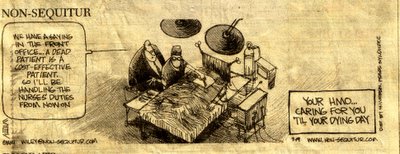 *Since this graphic may be hard to read - the insurance man says, "We have a saying in the front office... A dead patient is a cost-effective patient. So I'll be handling the nurses duties from now on." The statement on the right says, "Your HMO caring for you 'til your dying day.'"*
It is sad enough that in America over 45 million people (approximately 1/6 of the population) do not have health insurance. Yet it is even more ludicrous to think that one who has insurance can not even get coverage of life-saving treatments! I realize that the treatments were not guaranteed to work, but every person should be given the CHANCE to LIVE. Americans pride themselves on the fact that we have the "best health care technology" in the world, the best hospitals, the best doctors, with the shortest waiting periods. But I ask you - what good does the best MRI machine in the world do if you can't use it? What good does it do to have the smartest, most experienced, and most skilled doctors in the world if the insurance company can over-ride their plan for treatment? What good is a break-through, advanced, life-saving treatment if one can not be treated with it?
Normally I do not believe in using a single, possibly isolated case, to exaggerate or make a greater point, which often happens on the 10pm news - but this is different. The issue at hand is human life - and one person dying at the hands of the insurance companies is one too many! Everyone should have the opportunity for life - no trial or tribulations required. It is especially appalling when it is happening in the wealthiest nation on earth. And doesn't our Constitution say something about how no person shall "be deprived of life, liberty, or property..."
The health care system in America has a multitude of problems, with this being a single example of how off-course our country is heading in matters of health-care. The bottom-line here is that insurance companies should not ever have the final say about "life or death" matters. More generally, we need major health-care reform or else we will become a mockery to the rest of the world (if we have not already.) I can truly say I am absolutely disgusted...
This story reminds me of this (below) Non-Sequitur cartoon I used to laugh at - now it is no longer funny knowing that it is morbidly true.
 *Since this graphic may be hard to read - the insurance man says, "We have a saying in the front office... A dead patient is a cost-effective patient. So I'll be handling the nurses duties from now on." The statement on the right says, "Your HMO caring for you 'til your dying day.'"*
It is sad enough that in America over 45 million people (approximately 1/6 of the population) do not have health insurance. Yet it is even more ludicrous to think that one who has insurance can not even get coverage of life-saving treatments! I realize that the treatments were not guaranteed to work, but every person should be given the CHANCE to LIVE. Americans pride themselves on the fact that we have the "best health care technology" in the world, the best hospitals, the best doctors, with the shortest waiting periods. But I ask you - what good does the best MRI machine in the world do if you can't use it? What good does it do to have the smartest, most experienced, and most skilled doctors in the world if the insurance company can over-ride their plan for treatment? What good is a break-through, advanced, life-saving treatment if one can not be treated with it?
Normally I do not believe in using a single, possibly isolated case, to exaggerate or make a greater point, which often happens on the 10pm news - but this is different. The issue at hand is human life - and one person dying at the hands of the insurance companies is one too many! Everyone should have the opportunity for life - no trial or tribulations required. It is especially appalling when it is happening in the wealthiest nation on earth. And doesn't our Constitution say something about how no person shall "be deprived of life, liberty, or property..."
The health care system in America has a multitude of problems, with this being a single example of how off-course our country is heading in matters of health-care. The bottom-line here is that insurance companies should not ever have the final say about "life or death" matters. More generally, we need major health-care reform or else we will become a mockery to the rest of the world (if we have not already.) I can truly say I am absolutely disgusted...
Tuesday, January 31, 2006
Freedom, Freedom, Freedom
 If I were to sum up President Bush's 2006 State of the Union Speech, it would go something like this:
Freedom, Good.
Terrorism, Bad.
Freedom, Good.
Isolationism, Bad.
Freedom = Prosperity.
Taxes = Bad.
Next, Bush's foreign policy rhetoric can be packaged into one word, repeated constantly - Freedom. Admittedly, Bush talks strong on foreign policy and American security. With words like, "Every step toward freedom makes our country safer," it is hard to not be mesmerized by idealistic word-flinging. The problem is that you absolutely can not wield the word freedom like a sword in a Quentin Tarantino movie. Freedom isn’t something you can walk into Wal-Mart and buy in a plastic package with a yellow smiley face sign posted above. Freedom can not be given, and it surely can not be forced upon a people. Bush talks about Freedom as if a little fighting, a little encouragement, and a helping handful of encouragement will magically transform the Iraqi people, and subsequently the
Any ideal worthy of greatness can only be desired once it has been demonstrated as a positive alternative to the status quo. I offer this explanation as a warning to my fellow American citizens, and a thought for consumption to all the people of the World. As Americans, we must be mindful of the soil in which our President is trying to grow freedom. Americans may implicitly understand that liberty, freedom, and justice are inherently good things, but in a desert of chaos, others do not understand the same thoughts. When the mighty American Army occupies your back yard with guns blazing, it might just be difficult to tell the difference between enemy and foe. When the oil is cleaner than the water, it might not seem like fertile conditions for a new ideal to spring forth. This does not mean that freedom can not bud in the polluted waters; it simply means that we must be mindful of our own actions, our biases, and our hypocrisy. For the roots of freedom to truly grip the landscape, patience, imagination, belief, compassion, and nurture must be the key ingredients. The answers are not clear and they are not easy, but they will only come with a clearer view of the picture.
In finale, I do not believe that we should pull our troops rapidly out of
Saturday, January 21, 2006
The Power of Imagination
 On page 442 and 443 of his book, The World Is Flat, Thomas Friedman illustrates the power of imagination. He shows how it can go both ways - positive and negative – by contrasting the events of 11/9/89 and 9/11/01. His final thought urges us to work toward cultivating positive imagination. I agree with his sentiments 100%, which is why I’d like to take the time to explain and discuss this important concept.
Friedman starts by talking about 11/9/89 when
Friedman then contrasts 11/9/89 with 9/11/01 by showing that imagination and a smaller world can benefit the bad guys to. The terrorists have a cause and they can use the
I think one of the two most telling lines of this section is in the next paragraph - "There is one thing, though, that has not and can never be commoditized - and that is imagination."
By commoditized he means simplified and transformed into a commercial package. It also can't be turned into a mathematic formula that can be done with a computer or by a Chinese person or Indian behind a computer. It is the "imagination" he is saying that really makes a difference in the world. It makes a difference between a good service and a plain old service. It is the difference between a vanilla idea and one modeled after
Finally, and probably my most favorite paragraph of the whole book, Friedman writes, "Therefore, thinking about how we stimulate positive imagination is of the utmost importance. As Irving Wladawsky-Berger, the IBM computer scientist, put it to me: We need to think more seriously than ever about how we encourage people to focus on productive outcomes that advance and unite civilization - peaceful imaginations that seek to 'minimize alienation and celebrate interdependence rather than self-sufficiency, inclusion rather than exclusion,' openness, opportunity, and hope rather than limits, suspicion, and grievance."
I especially like the last part because it is what people with disabilities have been saying for a long time. This really underlines what I believe in. To use positive imagination to "stimulate...productive outcomes that advance and unite civilization." To "encourage people to...seek to...minimize alienation and celebrate interdependence..." To "seek...inclusion rather than exclusion" and "openness, opportunity, and hope rather than limits, suspicion, and grievance."
Friday, January 13, 2006
Honesty Is Hard to Come By
In my search for Personal Care Attendants (PCAs) I have learned much about the nature of people, and I did not like what I saw. The most troubling is that honesty is a rare virtue these days. As part of the hiring process I have prospective PCAs meet me at the local Borders bookstore for an interview after I pre-screen them on the phone. Of the 16 people I have set up interviews with over the past 2 weeks, only 6 have shown up - that is a miserable 37.5%!!! Of the 10 that did not show up, only 2 called me before their appointment to say they couldn't make it, and 1 let me know afterward why they missed. After the first round of interviewing I had two very qualified people in mind to hire, both with seemingly outstanding personalities, and both turned me down because they found other jobs. Now, I realize that withholding truth isn't always considered lying, and I realize looking for multiple jobs at once is common practice. However, what isn't honest is the way in which people lead me on. They show up and act as if this job is this great opportunity that they are excited about. The one guy that I really thought was good for the job, I told he had the job, and he said he was REALLY EXCITED about making a change in his life and coming to help me out. Then I asked him to come over for training on the weekend so he could start by the next week. On Thursday night we set up a training time for Saturday morning - no problems so far. Saturday morning comes - he doesn't show up. I call him, he says he slept in and he has outstanding tickets, he needs to take care of on Monday, but that he could come by later, since his friend could drop him off. Being the understanding and forgiving guy that I am, I let this by as he seemed to be telling the truth. I asked that he just come by sometime on the weekend for a training and then start work on Tuesday. It is not until Sunday night that I call and he FINALLY tells me he got another job. He dragged me along all that time when I could have been looking for someone else.
The second time around, I find two more people that I want to hire. I called one girl back, and that was on Thursday night (it is now Friday night), and then called her again tonight - NO REPLY. Keep in mind that this girl was very chatty and had a cell phone, which went off during our interview. She struck me as the type of girl who doesn't miss calls or messages. No answer, no callback, no nothing. Not even a courtesy call.
Now, just so we do not give up on the entire human race, there were some honest people. The second lady that I wanted to hire, wrote me back (in e-mail, because she had responded to an online ad) immediately after I said the job was hers and let me know she needed to think about it because the drive and pay might not be worth her time. This is very much understandable considering the price of gas, the distance she would have to travel, the number of hours I was offering, and the seemingly low pay. Also, another lady told me straight out after she missed her interview that she transposed her appointment times for her appointments for the day and asked nicely for a re-do but understood if I refused. Another lady called before to tell me she was sick and asked nicely for a re-do if possible. Was she sick? She sounded sick, but I guess you can never tell. Regardless, she had the courtesy to actually give me respect by calling me before her interview. This was especially nice because I was about to embark on a 1 mile trip in my wheelchair in 30 mph winds to get to the Borders.
In sum, hope is not all lost, even though true honesty, respect, and common courtesy is in short supply. I depend on PCAs to live my life and be independent. It is important that I hire a PCA ASAP since my life, independence, and dignity depend on it, and people are playing me as if I was McDonalds. If it wasn't for my girlfriend working overtime without pay, I would surely have either had to 1) move in with my parents or 2)move into the nursing home because I would have had no help. If I do not find someone by Tuesday and Wednesday I might have to drop some or all of my classes at Rockhurst! So as you can see this position isn't just any old job, and I try to let people know that, and yet they still can't be upfront with me. As I said, true honesty is hard to find.
Wednesday, January 11, 2006
My Favorite Show

The best show on television right now is hands down - Scrubs! I received (well, actually bought with Christmas money) Scrubs season 2 for Christmas. Just as with Season 1, I am constantly amazed at the depth, hilarity, and cleverness of this refreshing show. I also watched new season 5 episodes and they are just as witty as ever.
I am actually a late bloomer to Scrubs, as I only got into when Michael J. Fox made his guest appearance for a few episodes. I am ashamed that it took MJF to get me hooked, because this show was apparently always good. Actually I was afraid to watch it at first because the commercials made it look like a lame slapstick napfest. However, the commercials do not, and can not, give this show justice, because the each episode is so tightly woven together that taking out 30 seconds can not say much about the show.
What makes this show so good? The writing is the most clever, cunning, and FUNNY on TV today (or ever for that matter). The characters are believable, lovable, and real. The storyies are intricate with real-life themes and issues. The themes and issues are so subtly inserted into the show that sometimes you do not even know you are getting a lesson; you just think you are getting a good laugh. Some of my favorite shows also take a nice balanced step into seriousness too. Be warned, Scrubs can make you cry and laugh and think -- all at the same time. If you haven't given Scrubs a chance, you need to give it a try. If you can get a hold of season 2 "My philosophy" it is hands down the best episode I have seen so far. "My Old Lady" from season 1 is a very close second.
The music is an integral part to each episode. The writers and directors do such an amazing job of picking songs the capture the mood and setting of the characters and story of each episode. Whether they want you to laugh, cry, think, or a little of each, the music just picks up the story movement and takes it for a smooth coast along a wave, and always lands perfectly on the beach. Here is a great review of the music of Scrubs. I agree with everything in this article!
Tuesday, January 10, 2006
Good Help Is Hard to Come By
Today I had to restart my search to hire a personal care assistant. I had a candidate for the job and had offered him the job, and today I learn he is accepting a new job. So, after an exhaustive search that started around December 20th, I have to start over now on January 9th. I have one week to find potential candidates, interview them, check their references, organize our schedules, train them, and hope they do not find something else better first. By the way, if you live in
For those who do not know what a Personal Care Assistant (PCA) is - A PCA is someone who helps a person with a disability with the tasks that they can not do for themselves. Since I have Muscular Dystrophy and use a power wheelchair I need help with many tasks. Some of the tasks my PCA would do - clean, cook, take/place stuff on shelves, assist me in organizing, vacuum, transfer me on/off the toilet, drive me to school, drive me to do errands, and much more. A great candidate would even be able to be my hands on fixing my computer when the hardware has problems, but unfortunately it can be hard enough just to find someone to cover the basics.
Why is it so hard? Because in a job rich environment such as Johnson County Kansas is, it is hard to pay $8.00 an hour to have someone work non-traditional hours doing a non-traditional job. You don't need any experience to do this job, but apparently you do need to have nothing better to do. Medicaid sets the reimbursement rates for personal assistance in
Why is a PCA necessary? So I can live independently in the community. So I can continue my studies at Rockhurst. So I can graduate and get a job and pay taxes. PCAs are the vital tool that help many people with disabilities take control of their lives and contribute to society. In my case, if I don't have PCAs I am stuck, and would end up in a nursing home - a very bleak outlook for a twenty-five year old with great aspirations.
The intent of this post is not solely to gripe about Medicaid or the "system" but to educate. Money that goes towards helping people live independently in their own homes and communities is an example of social tax dollars put to good use. On average hiring help at home is cheaper than nursing home care, and it preserves the dignity of the person needing help, while also allowing them true freedom. Also, is the benefit of the PCAs who are hired to do the job and the money they give back to the community and the government; it is a domino effect. Unfortunately, the system needs some work, and even I admit it could be run better.
How can we help cut down Medicaid costs and make sure individuals keep their dignity and have true freedom and independence? Many ideas can go a long way, but I'll throw one out today. Give beneficiaries more freedom in hiring their care. Once you've met the requirements that you have a disability and need assistance, you should be able to spend the dollars as needed. Furthermore if the "reimbursement" came straight to me, instead of through the "payroll" agent, I could have more flexibility in how much I pay my PCAs and what hours they work. The more rules and bureaucracy that stands between the individual needing help and the tax dollars, the more the waste, and the less efficient the system. Let's start giving the money to the people who need it, and give them the freedom (with minimal restrictions) to use it in the way that best fits their needs. We can achieve maximum efficiency in Medicaid by not blanketing everyone with rigid one-size fits all stereotypes, and instead transforming to a more elastic all sizes fit every single one (who needs it) approach.
Sunday, January 08, 2006
Syriana, Corruption, and Oil
I do not consider myself a very harsh critc of movies, but Syriana has to be one of the worst movies I have seen in a long time; it is a wonder it got a fresh rating on rottentomatoes.com. I do not know who the film reviewer Nick Schager is, but he writes a good review of Syriana. I generally find movies with multiple storylines converging in the end intriguing, but Syriana overextended this plot device by offering too many characters and plots at once. No one character is on the screen long enough for you to get to know the character, care about the character, or even remember the characters name. What is even worse is that you realize in the end that most of the characters weren't even needed in the first place!
Furthermore, Syriana tries to hard to take itself seriously. I don't need a bad civics lesson on how oil rules the world and makes men corrupt. Anyone who can follow the news a little deeper than Fox News knows the world is dependent on oil and lots of corruption is happening with oil and energy companies -- Enron anyone??? The United States has a dependency on fossil fuels and Americans like to consume. It's not a good combo, and the type of people who are going to give Syriana a chance don't need a bad lecture on what's gone wrong. What we need is some answers and story about how we get beyond the slimy mess of oil. And can anyone tell me what the name Syriana has to do with anything???
Finally, as I said, what is really needed, whether in American politics, American media, World media, or Hollywood, is a real debate about how the United States can become energy independent. We need to use our ingenuity and technology to discover new energy sources, invent new fossil-fuel-independent cars, find new transportation modes, and empower a new generation of Americans who conserve. If we do not have leaders who step up to the plate on this issue we will face a major crisis. A crisis of environment and energy of catastrophic proportions. Global warming is real and fossil fuels aren't going to last forever, not to mention that depending on countries that hate the U.S. does not help our security any. I believe if we start preparing now, by uniting in the name of energy independence Americans can be a leader on these issues! Write a movie about that and I'll be the first one in line to watch!
Sunday, November 27, 2005
Rent the Movie - Reviewing the Reviewers
Rent: the Movie has, as of this posting, has a 51% rating at http://www.rottentomatoes.com. I had heard throught the grapevine that there was a large outpouring of negative reviews for the movie version of Rent. I chose not to read any reviews before seeing the movie (which I find is generally a good idea, since movie-watching is a process of individual revelation and discovery) and kept my mind firmly open while watching and subsequently enjoying this powerful movie. While my mind was open, I do have an outstanding bias, as I have seen the musical on broadway, albeit not the original cast version. My review of the movie is that the movie definitely captures the essence of the stage musical and captures the same raw emotion. In sum, I loved the musical and I loved the movie.
After my enjoyable afternoon at the movies with my girlfriend and my high praise for the movie, I dared brave the negative land of film reviewers. I am happy, and at the same time disgusted, to report that the majority of bad reviews came from critics who never saw the musical and rejected the whole storyline, or those who saw the musical and hated it on stage and equally detest it now. Therefore I can understand if you give the movie a bad review because you can't handle the plot of the original, afterall it handles some awfully heavy subject matter. At the same time I think it is awfully close-minded of anyone to reject this story on highly superficial grounds. Sure, on the surface this is a play about a bunch of friends who have AIDs, many who got it from arguably irresponsible and unethical activites (like needle sharing), all whom refuse to pay rent, have lots of gay sex, and whine about capitalism all day - I mean, come on, what a bunch of lazy, fascist, pretentious pricks, right? And there lies the rub. I don't condone not paying your rent, but this movie is about so much more than that. It is about hope, redemption, life affirmation, love, friends, the evils of rampant commercialism, humanity and did I say life, specifically take time to enjoying life in the present. Not only are the themes deep and exploratory in nature, the characters are real people with true depth and connectivity. I was emotionally pulled into the musical, and expanded that connection after seeing the movie. Therefore it is safe to dismiss any review from anyone who rejects the storyline - they don't like the story and that is their perogative. Anyone who has not seen the musical really doesn't have much say in reviewing the movie, or at least with any pretense of giving the movie a fully honest review.
With that said, I think the main objection from critics who saw the broadway show but did not like the movie is that the movie fails to connect to those who have not seen the musical. This is a legitimate concern. Since I am obviously biased, and since I have an emotional bond with the musical, and now the movie, it is hard for me to make an objective evaluation of this claim. What I can say is that this is surprising to me, as I must admit I did not follow everything during my experience on Broadway as I got lost at a few points, and often got lost in the music. The movie was an excellent chance for me to fill in the gaps, and visualize some aspects of the musical that were harder to grasp on a stationary stage set. Indeed the movie added another dimension to Rent that was helpful. Since the music (which I I can't get enough of) is taken straight from the musical, I can't help but think that the movie would be a great way to introduce Rent virgins who are willing to accept the premises to this powerful story. At the least I would figure that one would get lost in the same way I did during my introduction to Rent. This by no mean makes the music, characters, and themes hard to detect or to get entangled in, it simply means that one might not "get" the story on all levels. Though this tends to be the mark of any good story, especially in the movies, as any movie that can keep you discovering new themes and aspects after many viewings is the mark of a multi-dimensional story. Any serious movie buff gets this and my recent favorite multi-dimensional movie is the movie Crash - a MUST see. Anyways, that is for another blog entry.
Finally, others just did not like the movie adaptation. This is a matter of personal preference, though I surely did not see it. Since six of the eight actors were members of the original cast, the acting was superb. The sets were vivid, raw, and for the most part believable. The music - well it was the music from Rent - you either love it or hate it. There is some question as to whether the added lines of dialogue detracted from the original or added a new dimension. Personally, I think they made the plot easier to follow at times. At the very least I did not really see it as a major mark on the movie since the musical numbers do the real speaking anyway.
So there you have it. My best advice is to go see it yourself and see what you think - then come back here and let me know what you thought!
Saturday, November 26, 2005
Black Eyes For Black Friday
I must admit that I have in the past beaten the roosters out of bed to hunt good deals on the day after Thanksgiving. There is indefinitely a certain rush and sense of satisfaction in finding a great buy. This year I stayed at home, and I am glad I did. The so called "Black Friday" shopping is by far capitalism at its extreme. It is amazing to think that retailers wait for one day out of their fiscal year to push profits out of the red and into the black. It is also amazing how Americans have managed to turn the beginning of a holiday season, meant to be a time for sharing, giving, and togetherness, into an individualistic competition and rush to see who can spend their money quicker than the next guy. It makes you wonder if capitalism has truly gone amuck.
This year the pushing, shoving, and fighting to get a super-deal was no different than years past. Here is a good example of what I am talking about. This year Wal-Mart shoppers took the award for most aggressive as they showed their unified spirit by proceeding to knock each other out on their way to grabbing at $350 laptop computers. It looks like Black Friday turned into a Black Eye for many, and definitely a black eye for our country.
Forecasters are saying crowds were bigger this year and so was spending. This surprises me as I thought for sure that with more money spent on gas and heating this year and money donated to Tsunami, hurricane, and earthquake victims that pocketbooks would be empty - I know mine is. Maybe this is simply an indication of how far Americans are willing to go into debt to acquire material comforts and to appear as if they are caring benefactors to their friends and families. Or maybe my economic sense is backward. However, I am also surprised considering that I thought for sure online shopping would lure many shoppers and keep them from the stores. I can only hope that online shopping will be a saving grace for out country and a check on the true blackness of Christmas shopping in the future. With online shopping people can peacefully look for good deals and make more informed decisions. Shoppers can avoid the temptation to get close to others by pushing and shoving to the electonics aisle. It will also lead to spreading the shopping over all Christmas shopping days and not bungling it all in one day. Maybe Americans are not trusting of online shopping just yet, but as more people get $350 laptops from Wal-Mart you will see many finding online shopping much more comfortable - AND SANE!
Saturday, October 22, 2005
Elizabethtown
A little cliché, a little slow at times, a little recycled,
To be free is partly the idea that one is not burdened by the expectations of others. Drew, with a little help from his new friend Claire, contemplates the overrated nature of "success" and discovers the weight of following what "they" expect. Somewhere in the mess of spontaneous encounters with Claire, getting lost in his otherworld family and their Southern hospitality, and his aimless mental wandering Drew manages to cast aside the expectations of they. In doing so he discovers love, life, and freedom.
Carina Chocano of the LA Times says of Elizabethtown (click here for review):
"The movie gets lost sometimes, wandering down several stray paths to nowhere, only to suddenly change course and wind up in an unexpectedly exhilarating place. In this sense, it's the opposite of the quick commute of the average commercial movie. It's a meandering road trip instead."
It may be a recipe for feel-good mediocrity, but it is a feeling that I think we all need to get from a good movie every now and again. To walk away with a rejuvenation of spirit is a good feeling. At the same time, even if
Finally, let's not forget the soundtrack. The music is pristinely woven into the heart of this movie. A good movie isn't complete without a good soundtrack, and
Subscribe to:
Posts (Atom)